


For decades, marketing has revolved around one fundamental question: Who is my customer? Marketers built detailed buyer personas based on age, gender, income, education, location, interests, and so on. Entire campaigns were designed around identifying who someone was before deciding what message they should receive. And for a long time, that worked. But AI is subtly altering this question. Instead of asking, "Who is this person?" the focus is increasingly shifting to "What is this person trying to accomplish right now?" This represents a neuro-contextual shift that may seem minor, but it is far from it.
People rarely make decisions based solely on who they are. They make decisions based on the situation they're in, a problem they're trying to solve, and the uncertainty they're feeling. Emotion and urgency are driving their search. That's changing how recommendations are made, how content is surfaced, and ultimately, how brands should think about personalization.
The companies that learn to understand emotional context will create far more meaningful connections. And in the age of AI, that difference is becoming increasingly important.
The Great Marketing Pivot
One of the biggest changes happening in marketing today isn't a new platform, a new algorithm, or even a new AI model. It's a shift in perspective.
For years, marketers have organized audiences around identity. Today, AI increasingly organizes them around context.
Think about the difference.
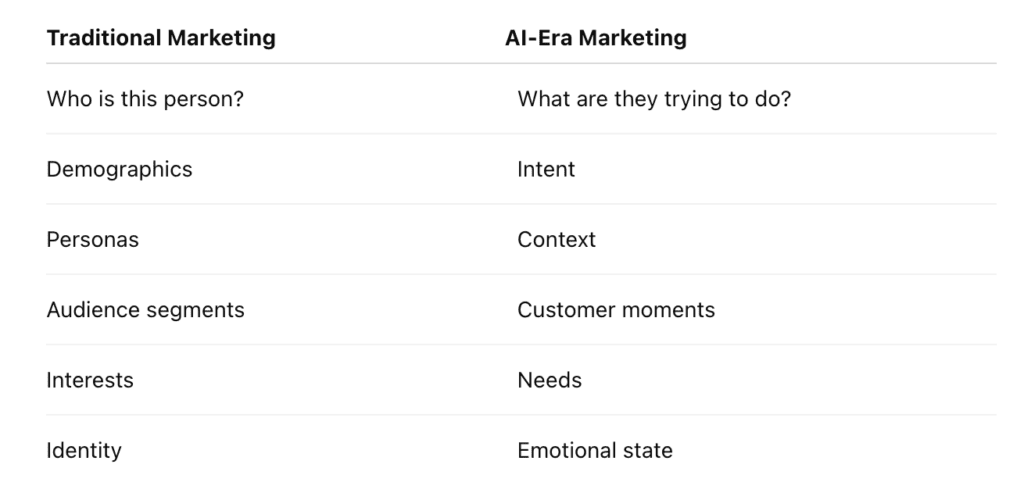
That doesn't mean demographics no longer matter. Age, profession, income, and interests still provide valuable context. But they're no longer enough on their own.
Because two people with nearly identical demographics can behave completely differently depending on what's happening in their lives. And AI is becoming remarkably good at recognizing those differences.
Why Identity Alone No Longer Tells the Whole Story
Imagine two customers. Both:
- 42 years old
- Live in Chicago
- Earn similar incomes
- Enjoy running
Traditional marketing would probably place them in the same audience. AI wouldn't.
One is training for their first marathon. The other is recovering from knee surgery.
One is searching for ways to improve performance. The other wants to exercise without pain.
Same demographic profile. Completely different motivations.
Now imagine two parents shopping for children's vitamins. One is feeling proactive. The other is worried after a recent doctor's appointment.
Again, the products may be similar. But the emotional context couldn't be more different.
The most effective message isn't determined by age or household income. It's determined by the question each person is trying to answer. That's why context is becoming such a powerful marketing signal.
AI Is Becoming Better at Understanding Moments
One of AI's greatest strengths is its ability to connect patterns that humans might overlook. Instead of seeing isolated searches or clicks, AI increasingly interprets sequences of behavior.
For example, Someone researching:
- Healthy recipes
- Meal planning
- Grocery delivery
- Blood sugar management
is likely in a very different mindset than someone searching:
- Birthday cakes
- Party decorations
- Catering services
- Local bakeries
Even if those two people share similar demographic profiles.
AI doesn't simply see keywords. It analyzes the context and begins to recognize the story behind the search.
That's incredibly valuable because customer intent is rarely captured in a single interaction. It's revealed over time.
The more signals AI can interpret, the more relevant recommendations become.
The Same Person Can Be Five Different Customers
The core idea would be: We often think of people as belonging to one persona. In reality, the same individual constantly shifts between emotional contexts. For example:
- Monday morning: a manager looking for productivity tools.
- Tuesday afternoon: a parent researching healthy lunches.
- Wednesday evening: someone planning a vacation.
- Thursday: a patient looking up knee pain.
- Saturday: a runner shopping for new shoes.
Same person. Five different emotional journeys, buying motivations, and opportunities for your brand to be relevant.
Emotion Is Often the Hidden Driver Behind Every Purchase
Here's something marketers sometimes forget. People don't buy products. They buy progress.
- Relief
- Confidence
- Convenience
- Hope
- Peace of mind
- Status
- Belonging
In other words, emotion often sits underneath nearly every buying decision (1).
Think about some common purchases. A meal planning app. Is someone buying software? Or are they buying relief from the stress of figuring out dinner every night?
A standing desk. Is the customer buying furniture? Or are they trying to reduce back pain and feel better during the workday?
Travel insurance. Is it about the policy? Or the peace of mind that comes with knowing they're protected?
The emotional driver matters because it shapes how people evaluate solutions.
And increasingly, AI is becoming better at identifying emotional drivers from behavior, language, and context.
That doesn't mean AI understands human emotions the way another person does. It means it recognizes patterns associated with different needs and motivations.
For marketers, that's a significant distinction. Because it shifts the conversation away from: "Who should see this ad?" Toward: "What emotional need does this content address?"
That's a far more useful question. And one that often leads to better marketing.
Welcome to Neuro-Contextual Marketing
This shift comes from neuro-contextual marketing (2). Not because marketers suddenly need neuroscience degrees. And not because brands should try to manipulate emotions. Quite the opposite.
The idea is remarkably simple. Instead of building campaigns around static identities, build them around dynamic moments.
- Meet people where they are.
- Understand the situation they're navigating.
- Recognize the uncertainty they're trying to resolve.
- Help them move forward.
That's not manipulation. That's relevance.
The brands that succeed in the AI era will become better at understanding the context surrounding each interaction. And that's a much more human approach to personalization.
Stop Building Personas. Start Mapping Emotional Journeys
Traditional buyer personas have been a marketing staple for decades. You've probably seen some version of them.
Sarah:
- 38 years old
- Marketing Director
- Lives in a suburb
- Married with two children
- Household income: $180,000
- Interested in wellness and technology.
There's nothing wrong with this. But there's one problem. It tells you almost nothing about why Sarah is buying today. Is she:
- Overwhelmed by work?
- Preparing for a product launch?
- Trying to solve a problem quickly?
- Researching for her boss?
- Comparing vendors?
- Excited about a new opportunity?
- Worried she might make the wrong decision?
Those questions often influence purchasing decisions far more than age or income ever will.
Instead of building personas, start mapping emotional journeys. Ask:
- What is the customer feeling before they discover us?
- What uncertainty are they trying to reduce?
- What emotion do we want them to feel after interacting with our brand?
Those answers create marketing that feels considerably more relevant because it reflects the customer's situation, not simply their identity.
What This Looks Like Across Different Industries
One reason this shift is so powerful is that it applies almost everywhere. The emotional context changes. The strategy doesn't.
Ecommerce
Imagine two people shopping for the same standing desk. One wants to improve productivity while working from home. The other person recently developed chronic back pain.
The product is identical. The emotional journey isn't. One customer is pursuing optimization. The other is looking for relief.
Those customers don't need the same messaging.
Healthcare
Two people searching for information about cholesterol management may have completely different motivations. One is trying to prevent future health problems after seeing a family member struggle with heart disease. The other just received unexpected lab results and feels anxious.
Both searches may look similar. The emotional context behind them couldn't be more different. Content that acknowledges those differences naturally feels more supportive.
B2B Marketing
This shift is especially important in B2B. Companies often segment by:
- Industry
- Company size
- Job title
Those variables still matter. But consider two Marketing Directors. One has six months to evaluate vendors. The other needs a solution before next week's board meeting. Same role. Very different buying experience.
One values exploration—the other values confidence and speed. Your messaging should reflect that.
Fitness
Think about someone searching for protein powder. One customer wants to maximize muscle growth for an upcoming competition. Another wants enough strength and energy to stay active with their family.
Same category. Different aspirations.
Brands that recognize those differences create stronger emotional connections.
Real Brands Already Marketing Through Context
Many of the world's strongest brands are already moving in this direction, even if they don't describe it this way.
Spotify
Spotify doesn't simply recommend music based on your age or location. It considers what you're doing.
- Working
- Studying
- Exercising
- Relaxing
- Driving
The context shapes the recommendation. The playlist becomes relevant because it fits the moment.
Netflix
Netflix has evolved beyond recommending content based solely on genres. Its recommendation engine continuously adapts to viewing behavior, recent interests, and changing preferences.
Your recommendations reflect what you're interested in now, not necessarily what you watched a year ago.
Headspace
Headspace organizes much of its experience around emotional needs rather than demographic categories.
Feeling stressed? Having trouble sleeping? Preparing for an important presentation? The platform helps users find content based on what they're experiencing in that moment.
Amazon
Amazon has long recognized that context matters.
A customer shopping for a baby registry isn't simply another e-commerce shopper. They're entering an entirely different stage of life.
Recommendations, bundles, reviews, and suggested products increasingly reflect that broader context.
The lesson isn't to copy these companies. It's to recognize the pattern. The strongest personalization increasingly starts with understanding the situation, not just the shopper.
How AI Makes Personalization Feel More Human
Ironically, one of the biggest fears surrounding AI is that it will make marketing feel less personal.
In reality, the opposite can happen. When used thoughtfully, AI can help brands become more empathetic.
Instead of sending the same message to thousands of people, AI can help identify:
- Where someone is in their decision-making journey
- What information they're missing
- What concerns they may have
- What type of content is most helpful next
That's a very different use of personalization than simply inserting someone's first name into an email. It's about relevance.
The goal is to understand their current situation well enough to help them genuinely move forward.
That's where AI becomes most valuable, not as a replacement for human connection, but as a tool for creating more of it.
Questions AI Is Already Trying to Answer
As marketers, we often focus on audience demographics. AI increasingly focuses on a different set of questions. Instead of asking:
- How old is this customer?
- Where do they live?
- What's their income?
AI is becoming better at asking:
- What problem are they trying to solve?
- How urgent is it?
- What information are they still missing?
- How confident do they feel?
- What's preventing them from taking action?
- What would help them make a better decision?
Notice something. Almost none of those questions are demographic. They're neuro-contextual.
And they often lead to much better marketing because they reflect how people actually make decisions.
The future of segmentation isn't necessarily knowing more about your audience. It's understanding more about the moment they're experiencing.
The Neuro-Contextual Framework
So how do you actually put this into practice? You don't need to throw out your personas tomorrow. Demographics, firmographics, and customer segments still have value.
The opportunity is layering emotional context on top of them. Think of it like this:
Start with identity
Who is this person? Examples:
- E-commerce shopper
- Marketing Director
- Gym owner
- Parent
- Healthcare professional
Identity gives you context. But it shouldn't stop there.
Add the situation
What's happening in their world right now? Are they:
- Launching a business?
- Recovering from surgery?
- Planning a vacation?
- Preparing for an important presentation?
- Researching a new software platform?
- Trying to improve their health after a difficult doctor's appointment?
Context changes everything.
Understand the emotional state
Now ask: How might they be feeling? Perhaps they're:
- Overwhelmed
- Excited
- Hopeful
- Uncertain
- Frustrated
- Curious
- Confident
- Anxious
Remember, people rarely buy products simply because they fit a demographic. They buy because they want to move from one emotional state to another.
From uncertainty to confidence.From stress to relief. From confusion to clarity.
Create content that helps them move forward
Finally, ask yourself: "What would genuinely help someone in this moment?" Sometimes it's education; other times it’s reassurance, comparison content, or a simple next step.
That's where marketing becomes significantly more useful. And usefulness is one of the strongest competitive advantages any brand can build.
Audit Your Marketing Through an Emotional Lens
Here's a simple exercise you can do with your team this week. Pick one landing page, email campaign, or product page. Instead of reviewing it from your perspective, review it from your customer's. Ask:
- What emotional state is someone likely to be in upon arrival here?
- Does our messaging acknowledge that?
- Are we creating confidence—or adding more complexity?
- Are we answering the questions they're actually asking?
- What uncertainty still exists after reading this page?
- Does the next step feel obvious?
You might be surprised by how often marketing answers the questions brands want to communicate rather than the ones customers actually have.
Sometimes the smallest shift in messaging can dramatically improve how relevant your content feels.
Quick Wins You Can Implement This Week
If you're interested in experimenting with neuro-contextual marketing, you don't need to redesign your entire strategy.
Start small.
Review your customer reviews
Look beyond product feedback. Pay attention to emotional language. Look for phrases like:
- "I was nervous..."
- "I finally felt..."
- "I wasn't sure..."
- "This gave me confidence..."
- "I wish I had found this sooner."
Those insights often reveal the emotional journey behind the purchase.
Read support conversations
Customer support is one of the richest sources of emotional context. People explain:
- What they're struggling with
- What's confusing
- What they're worried about
- What they're hoping to achieve
That's marketing intelligence hiding in plain sight.
Rewrite one landing page
Before talking about features, acknowledge the customer's situation. For example:
Instead of: "Our software automates reporting." Try: "If you're spending hours building reports every week, you're not alone. Here's how to get that time back."
Notice the difference. One starts with the product. The other starts with the customer's reality.
Review your personas
Don't delete them. Expand them. For every persona, add:
- Current goal
- Biggest concern
- Emotional state
- Desired outcome
- Questions they're trying to answer
You'll immediately have a richer understanding of your audience.
Common Mistakes Brands Should Avoid
As AI becomes more sophisticated, it's easy to misunderstand what personalization actually means.
Mistaking Personalization for Personal Data
The goal isn't collecting more information about people. It's using the information you already have more thoughtfully.
Customers don't necessarily want brands to know everything about them. They want brands to understand their needs. Those are very different things.
Assuming Demographics No Longer Matter
Identity still provides valuable context. The opportunity isn't replacing demographic segmentation. It's enhancing it with behavioral and emotional insights.
Think of it as moving from a static snapshot to a living picture.
Making AI Feel Creepy
The best personalization feels helpful. Not invasive.
If customers feel like they're being watched instead of supported, you've crossed the line.
Good AI reduces friction. It doesn't create discomfort.
Forgetting That Humans Are Still Making the Decisions
AI can identify patterns, surface insights, and recommend content.
But empathy, creativity, and judgment remain distinctly human strengths. The best marketing combines both.
The Real Takeaway
For years, marketers have invested enormous effort into understanding who their customers are. That work still matters. But it's no longer enough.
AI is changing the conversation. The brands that stand out won't necessarily be the ones with the most detailed customer profiles. They'll be the ones who understand what their customers are experiencing in the moment.
Because context shapes decisions, emotion shapes action. And relevance builds trust.
The future of personalization is understanding the moment they're in and showing up with the right message when they need it most.
That's not just smarter marketing. It's more human marketing.
Ready to Make Your Marketing More Relevant in the AI Era?
As AI continues to reshape neuro-contextual search, personalization, and customer experiences, the brands that win will be the ones that combine technology with genuine human understanding.
If you're looking to evolve your audience strategy, improve your messaging, or create content that connects with customers based on real needs, not just demographics, we'd love to help.
Schedule a call with our team to explore how AI, customer insights, and smarter content strategies can help your brand build stronger relationships and better marketing.
No pressure. Just a conversation about creating marketing that's as relevant as it is human.