

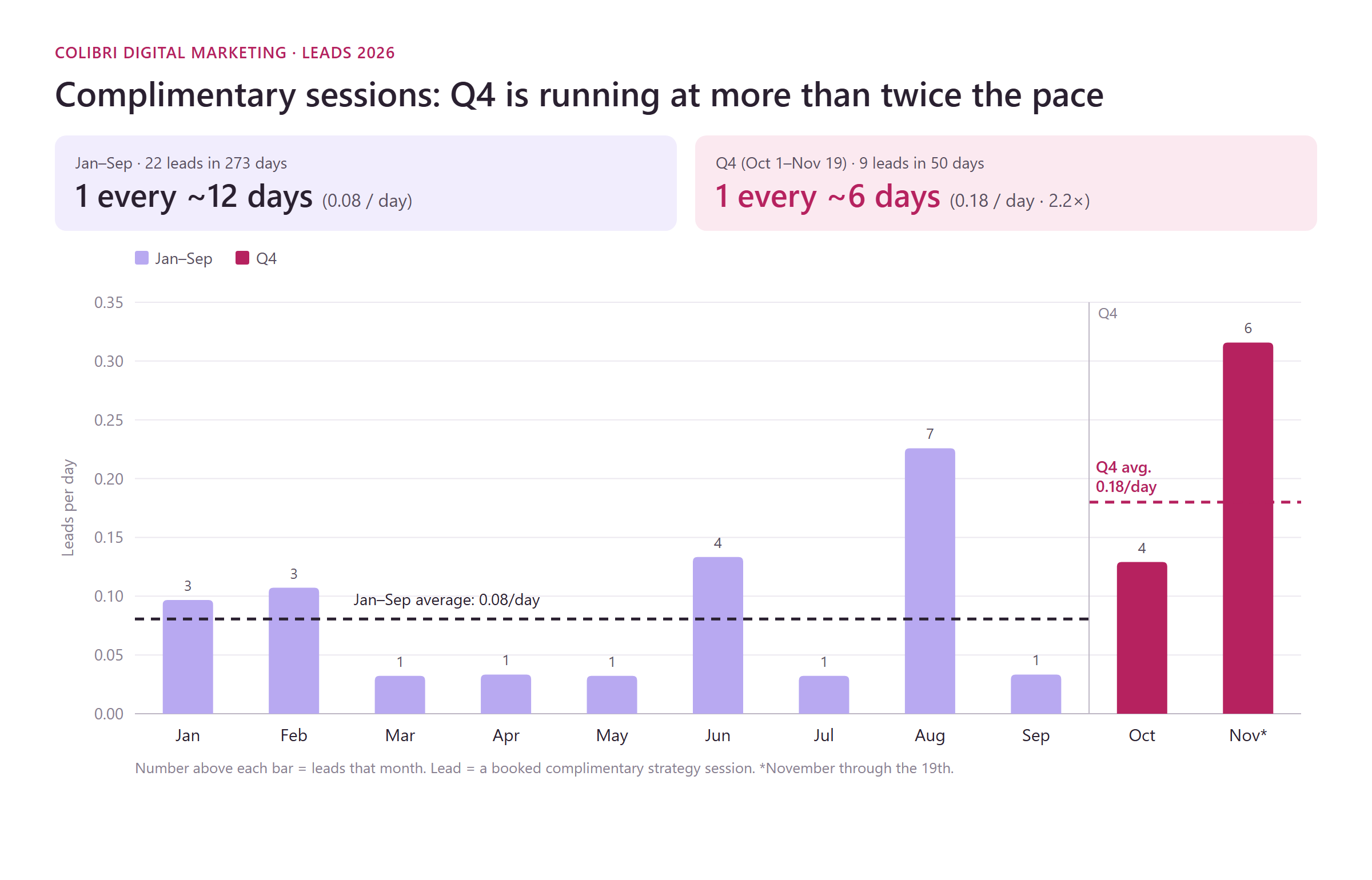
For us at Colibri, Q4 is our strongest season for new leads. In 2026, from January to September, someone booked a complimentary strategy session with us about once every 12 days. So far in Q4, it’s been about once every 6 days, more than twice the pace, and November alone brought 6 bookings in 19 days (see chart below).
Plenty of year-end advice says to coast through the quarter and start fresh in January. That is not what we see. Budgets land, year-end decisions get made, and the businesses that spent the year comparing options start choosing one.
The firms that win Q4 are ready for both halves of it: the new lead who writes to you in November, and the warm list you have been building all year.
This guide is for B2B firms where a deal takes anywhere from 6 to 24 months and one signed client moves the year: founder-led consulting firms, boutique wealth managers, and similar organizations. For the full-year view, see our complete B2B digital marketing strategy guide.
Q4 Is When B2B Buyers Move
Buyers are not coasting either. MNTN, a connected-TV ad vendor, reported that its B2B advertisers’ highest-revenue month in Q4 2024 was November (1).
Budgets are part of it. Although nobody publishes the date companies lock next year’s numbers, our read is that budgets take shape in the fall and close by year-end.
By the time a new lead contacts you, they’ve usually narrowed their options to a few firms already. In 6sense’s 2025 buyer study, buyers chose the vendor they ranked first before talking to a seller 77% of the time (2). The person who writes to you in November has already ranked a favorite, and your job is to be on it and to make the next step easy.
How to Develop a Q4 B2B Marketing Strategy and Why It Matters
Developing an effective B2B marketing strategy in Q4 allows companies to capitalize on year-end budget allocations and decision-making momentum. Rather than waiting until January to restart outreach, taking proactive steps in Q4 ensures your sales pipeline remains active and ready to convert high-intent buyers. Here’s how to start.
Step 1: Be Ready for the Lead Who Arrives
A buyer with a shortlist is looking for a reason to cut a name, so give them as few reasons as possible. Three things do most of the work:
- A reply the same business day. Name the person who owns the inbox through December (the contact form should not go to “whoever sees it first”), and set an out-of-office that points to a booking link.
- Proof a stranger can find in two minutes. A page of results, a one-page description of how you work, and a current founder profile. If your newest case study is from 2022, it will read like it.
- One clear next step. A calendar link, plus two lines on what happens in the first call, so saying yes feels small.
The Same-Day Reply
The first answer does not have to be an essay. It has to prove a real person is on the other end. Save a short reply now, so that answering a new inquiry takes two minutes, and change only the bracketed parts:
Hi [Name], thank you for writing.
[One line in their own words about what they asked, so they know you read it.]
The easiest next step is a 30-minute call. Here are two times this week, or pick your own: [booking link].
If you want to look around first, here is a one-page look at how we work: [link].
[Your first name]
Send it the same business day, even when the full answer needs another day. A short, plain note today beats a perfect one on Thursday.
The Proof Page a Stranger Can Read in Two Minutes
Ask someone outside your firm to spend two minutes on your site, then tell you what they found. They should be able to see:
- Who you help and what changes for them, on the first screen.
- Two or three results, each with the kind of client, what you did, and what happened, in a number or a plain sentence.
- How you work, including what the first 90 days look like.
- A founder or advisor profile with a current photo and recent work.
- A booking link at the bottom of every page that matters (more on this in our guide to web design for lead generation).
Whatever they find in their review, it’s something you can quickly update before that first send. You don’t need to do a whole rebuild.
Step 2: Count What You Collected
New leads are half of the quarter. The other half is already in your files. Open a blank page and list every group of people who already know you. You will probably find more than you remember, and they are worth more than any cold audience you could buy. In Ebsta and Pavilion’s 2025 benchmarks, existing relationships won 45% of the time and new logos won 19% (3). That 45% measures expansion with current customers.
The Five Pools
Each pool has a minimum size before it works in paid, and a different move once you have it:
| Warm pool | Where it lives | Minimum to use it in paid | The Q4 move |
| Open proposals | Your CRM or sent folder | Too small for ads | A personal note this week, from you |
| LinkedIn engagers | People who engaged with your content in the past year | 300 matched members | Retarget with proof content |
| Email list | Your email platform | 100 active users in 30 days for Google | Short nurture, plus Google Customer Match |
| Referral partners | CPAs, attorneys, former colleagues | None; they are people, so no list is needed | A year-end call with something useful to share |
| Current clients | Your CRM | Skip paid | A year-end review that ends with “who else should we be talking to?” |
Small lists belong to people. Big lists belong to ads.
The Pipeline Math, Worked Through
Here is how the counting turns into a plan. These are round numbers for illustration (real pipelines never add up this nicely), so swap in your own:
| Line | Example |
| Goal for new signed work by year-end | $200,000 |
| Already signed | $80,000 |
| Gap to close | $120,000 |
| Open proposals (six at $40,000 each) | $240,000 |
| Win rate on proposals, say 30% | $72,000 expected |
| Still uncovered | $48,000 |
The proposals you already sent should cover most of the gap, so the best Q4 hours go to them: a personal note, a one-page answer to whatever stalled each one, maybe a case study that answers their pain points. Raising that win rate from 30% to 40% is worth another $24,000, and it doesn’t require finding a new lead.
The remaining $48,000 is January’s number. With cycles of 6 to 24 months, a first call in late November rarely signs by December 31, so that pipeline needs to start now, beginning with the warm pools: proposals, engagers, your list, partners, and clients.
Step 3: Point Paid at People Who Are Already Leaning In
Who Sees the Ads First
Start with the warm list. Thought Leader Ads from the founder or advisor let you sponsor a real post from a real person, and buyers see a face they already recognize. LinkedIn’s current specs allow a single image or video post, with no added link or button, so the post has to earn the click-through on its own. Pick the piece of proof your warm audience would most like to see again.
The Lists to Build
Then build the lists this week. LinkedIn needs 300 people in an audience, and Google needs 100 active in the last 30 days. For a small firm, those thresholds are finally within reach. You can only retarget the people you can see, so if your CRM and your ad accounts do not know who engaged, fix the tracking before you add spend.
Where the Cold Money Goes
For new leads, spend with care. In HockeyStack’s B2B software data, Q4 took 31% of annual LinkedIn spend and returned 20% of marketing-qualified leads, which means leads from LinkedIn cost more in the very quarter everyone is chasing them (4). Put the cold-audience money behind high-intent search, where people are typing what you sell into Google, and keep LinkedIn pointed at people who have already engaged with you.
Step 4: Write for the Committee Member You Never Met
Your champion is already sold. The deal is stuck on someone else. Forrester found that 86% of B2B purchases stall, with an average of 13 people involved in the decision (5). Somewhere in that 13 is a finance lead or a partner who has never heard you speak (and holds the pen).
Write for that person. Start with three pieces:
- A one-page summary your champion can forward without you in the room: the problem, the plan, the first 90 days.
- A plain answer to the question finance always asks: what does this cost, and what happens if it doesn’t work?
- A short note on what the first month looks like: in the order it happens, so the risk feels smaller than the decision.
Send these to the one person the deal is stuck on. Content that unsticks a deal looks like a good briefing.
The Forwardable Page, Outlined
Keep it to one page, with four short blocks that someone who missed every meeting can follow:
- The problem: two sentences in the buyer’s own words, taken from your calls.
- The plan: three deliverables, each with a date.
- The first 90 days: what happens in month one, month two, and month three.
- The cost and the exit: the fee, what is included, and the smaller first step they can take if they are not ready for the whole thing.
Step 5: Send a Short Nurture, and Start January Warm
A stalled proposal needs one specific, useful note. Write it so the reader can say nothing and lose nothing: “No need to reply. If the timing changes, this is the one-page plan we’d start with.” Then do the same, lighter, for the wider list: one useful thing, one line about what you are working on in January, and a way to opt out.
The Stalled-Proposal Note, Start to Finish
Here is the whole note:
Subject: One page on [the thing that held this up]
Hi [Name],
I kept thinking about [the question that stalled it: scope, price, or timing]. I put the answer on one page: [link].
If it helps, we could start smaller, with [the first step], and decide on the rest in January.
No need to reply. If the timing changes, this is the one-page plan we’d start with.
[Your first name]
The note names the real obstacle, gives the decision-maker something they can use, and offers a smaller yes. Send it from you, not from a sequence.
Protect January
Two moves protect January. Cut cold spend after about December 20, and keep a low-cost retargeting budget running so the warm list stays warm. And plan a January kickoff note now, because deals that slip past December often resurface in Q1, and so do the new leads who arrived too late to sign.
The Calendar, October to January
| Window | Focus | Why it works |
| Early October | Audit open proposals and warm contacts; build retargeting lists; check who answers the inbox | Lists need time to reach their minimum size |
| Mid-October to mid-November | Retarget warm audiences with proof content; run Thought Leader Ads from the people buyers know | Warm beats cold on win rate |
| Already mid-November? Start here | This week: name who answers new inquiries, and send each open proposal a personal note. Next week: build one LinkedIn and one Google list. Before Thanksgiving: publish one proof piece from your founder | November was the strongest Q4 month in one ad vendor’s B2B data, and a personal note needs no list to work |
| December 1 to 20 | Answer new leads fast; close what is moving; year-end reviews and referral asks | Buyers are finishing, and some are starting |
| December 20 to 31 | Cut cold spend; keep low-cost retargeting; cover the inbox; schedule the January kickoff | Attention is lowest; don’t pay to talk to an empty room |
| Early January | Restart; reach out to the deals that slipped and the leads that arrived late | Stalled Q4 deals resurface in Q1 |
For Wealth Managers: December 31 Is Your Content Calendar
If you run an RIA, the year hands you dated reasons to be useful. Required minimum distributions are due by December 31 each year after the first. Roth conversions have a hard December 31 deadline with no April extension. Annual gifts have to be made in the calendar year. Educational posts and notes about these topics are the lowest-risk lane in your whole marketing plan, and your clients and their CPAs are reading about them anyway.
It is also the best moment to ask for introductions, which is the biggest source of new clients for an advisor. About 43% of consumers found their advisor through a friend or family member, against about 4% through search or AI (6). The year-end review meeting is where that happens, and about 20% came through a CPA or attorney, so your referral partners matter too.
Run it past compliance. A boosted advisor post counts as an advertisement for the firm, so it needs your compliance officer’s sign-off before you sponsor it, and it needs to be archived afterward. Client testimonials and third-party ratings in retargeting need their disclosures inside the ad itself, not behind a link, and that is where the SEC’s December 2025 risk alert found firms falling short (7). This is a planning guide and not legal advice.
Find Out What Your Pipeline Can Close by December 31
Run the same math with your own numbers. The Pipeline Reality Check takes your goal, your open proposals, and your win rates, and shows how much of this quarter’s gap those proposals should cover and when next quarter’s conversations have to start.
If you’d like a second pair of eyes on your pipeline, schedule a complimentary call with our team.