


If you have a brand in 2026, you probably already have a blog. A couple of lead magnets somebody spent a weekend building (or a month!). An email list with a few thousand names on it. A couple of ad campaigns running in the background. A homepage the whole team argued over for a quarter.
Each piece is fine on its own. But when you put them together, nothing connects them.
It’s like picturing your marketing as rooms in a house. Each one is furnished, lit, ready for a guest. Nobody built the hallways.
If that’s the case, you don’t have a marketing system. You have a pile of good rooms.
Marketing architecture is the deliberate design of how those pieces connect: which one hands a visitor to the next, in what order, and why. Your marketing is probably not underperforming because any single piece is weak. It is underperforming because the pieces don’t talk to each other.
The pieces work. The system doesn’t.
We’re used to each channel running its own race. Paid chases a lower cost per click. Email chases a higher open rate. The blog chases traffic. Nobody owns what happens to the person who touched all three.
Campaigns don’t build on each other either. One month gets a strong push, then fades. Three months later, another push runs, starting from zero again. Last quarter’s insight never reaches this quarter’s brief.
And when someone asks which spend produced the deal, the honest answer is a shrug or the typical “let me check the data”—which probably shelves the issue there. Not because nobody is watching the dashboards. But because the dashboards were never built to answer that question.
The market makes it easy to fall into this. The 2026 State of Martech report counted 15,505 commercial marketing technology products, up from 150 in 2011 (1). Roughly 100 tools exist today for every one that existed 15 years ago. Each got bought to solve a real problem the week it showed up. Few were built to talk to each other.
Most marketing teams stepped into the pretty trap, because more tools were never the goal. A shared read on the customer was. But now we have more software, each holding a separate slice of the same person.
A pile of assets is not a marketing architecture.
A strategy says what to do and when. An architecture says how the things you’re already doing connect.
You can run a sharp strategy through a pile. The pile can even look impressive: good design, sharp copy, decent numbers on any single channel you check. It still flattens growth, because nothing routes what one piece learns into the next.
A pile grows. But a system compounds.
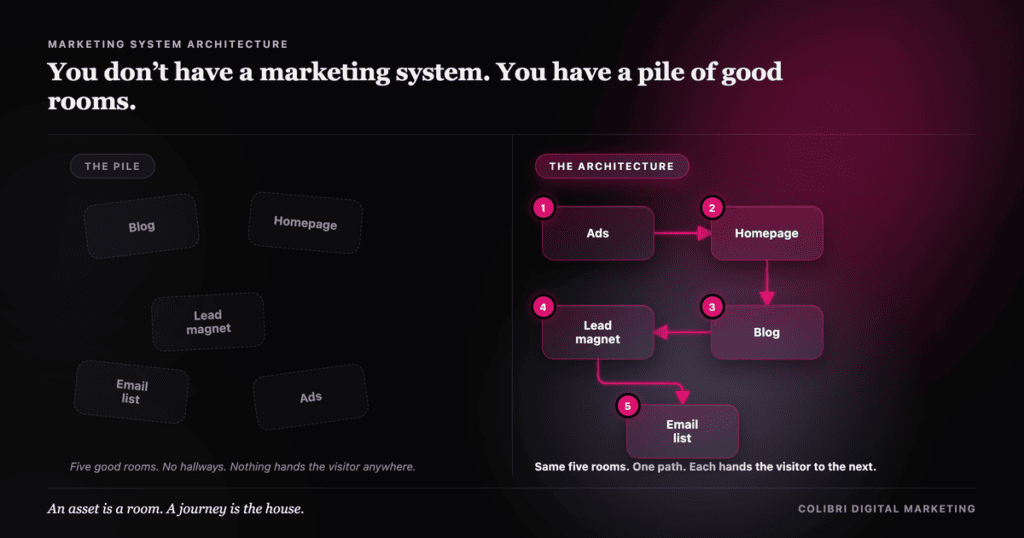
Marketing architecture is just the handoffs.
Run one test on every piece of marketing you own: does this piece hand the reader somewhere, and does something hand the reader here? Call it the handoff. A piece that fails both is an orphan, an asset built, published, forgotten.
Five layers have to agree for the handoffs to hold.
- Strategic architecture. The roadmap and the one constraint standing in the way; skip it and every layer below runs tactics with no shared knowledge of what they’re for.
- Demand generation. SEO, content, and paid working together to produce a qualified lead, not just a visit; skip it and traffic and pipeline stop being the same conversation.
- Experience and lifecycle. What happens after the click: onboarding, nurture, the flow that turns a first touch into a returning customer. Skip it, and demand generation buys one transaction rather than a relationship.
- Analytics and operations. The one shared set of facts every other layer works from; skip it and three people can pull the same metric and land on three different numbers, all defensible, none trusted.
- Brand and creative systems. What keeps the voice recognizable as more people produce more content across more channels; skip it, and growth costs you coherence.
You might be asking yourself, isn’t this just marketing operations with a new name?
No. Operations is the tooling and the workflows: which platform sends the email, who approves the spend, how a ticket moves through the queue. Architecture sits above that. It’s the decision about what the customer’s path should be, the decision operations then carries out.
Operations runs the machine, where marketing architecture decides where it points.
Design from the journey, not the asset.
Most brands build by accident (or out of urgency).
Someone needs a landing page, so one gets built. Nobody designs the path between it and the ad that sent the click, or the email that should follow.
At small size, the gap barely shows. A founder can patch the hallways by hand, remembering who came from where and following up personally.
But when the team grows, that breaks. More channels mean more handoffs. More people touching the funnel means more history that has to travel with a visitor rather than living in one person’s head.
The pain that follows usually gets misdiagnosed. Customer acquisition cost creeps upward with no single obvious cause: nobody can trace which channel is earning its spend.
Headcount grows to keep pace with the workload. Revenue doesn’t grow at the same rate because more hands compensate for missing connective tissue instead of doing work that compounds.
Ask three people on the team what’s working. You’ll get three different answers, each of them right in their own heads but maybe not completely trustworthy. The underlying data was never built to answer that question.
None of it shows up as one crisis. It shows up as a slow tax on every dollar and every hire, easy to miss until someone finally adds it up.
One connected world beats ten new pieces.
When growth stalls, the instinct is to do more. We create another landing page, another lead magnet, another campaign.
A stack of disconnected tactics restarts from zero every time it runs. A system routes what each cycle learns back into the next, so the third campaign starts smarter than the first.
Building those connections is less exciting to greenlight than a new campaign. It’s also the one move that compounds.
Let’s start creating those systems instead of building more rooms.
Run the handoff test on your own marketing.
If you’re wondering whether you need to fix your system, answer five questions with a straight yes or no.
- Does your highest-traffic piece send visitors to a page built for what brought them, or to a generic homepage?
- When someone touches three channels, does anything downstream know it happened?
- Can you name the one piece that sits between a first visit and a sale?
- If your best asset vanished tomorrow, would you know exactly what to rebuild?
- When something teaches you what works, does that lesson show up anywhere else?
Two or more “no” answers mean the fix isn’t a new campaign. It’s the connections between the campaigns you already have.
Start where every real fix starts:
- Audit what already exists, room by room.
- Name the one constraint holding growth back.
- Architect the connections before you build another asset.
Turn the pile into a place people can walk through.
Marketing architecture is something our team of experts loves doing. Schedule a complimentary call now and let’s start building systems that compound your assets, landing pages, and campaigns.
You don’t need another room. You need the path between the ones you already have.